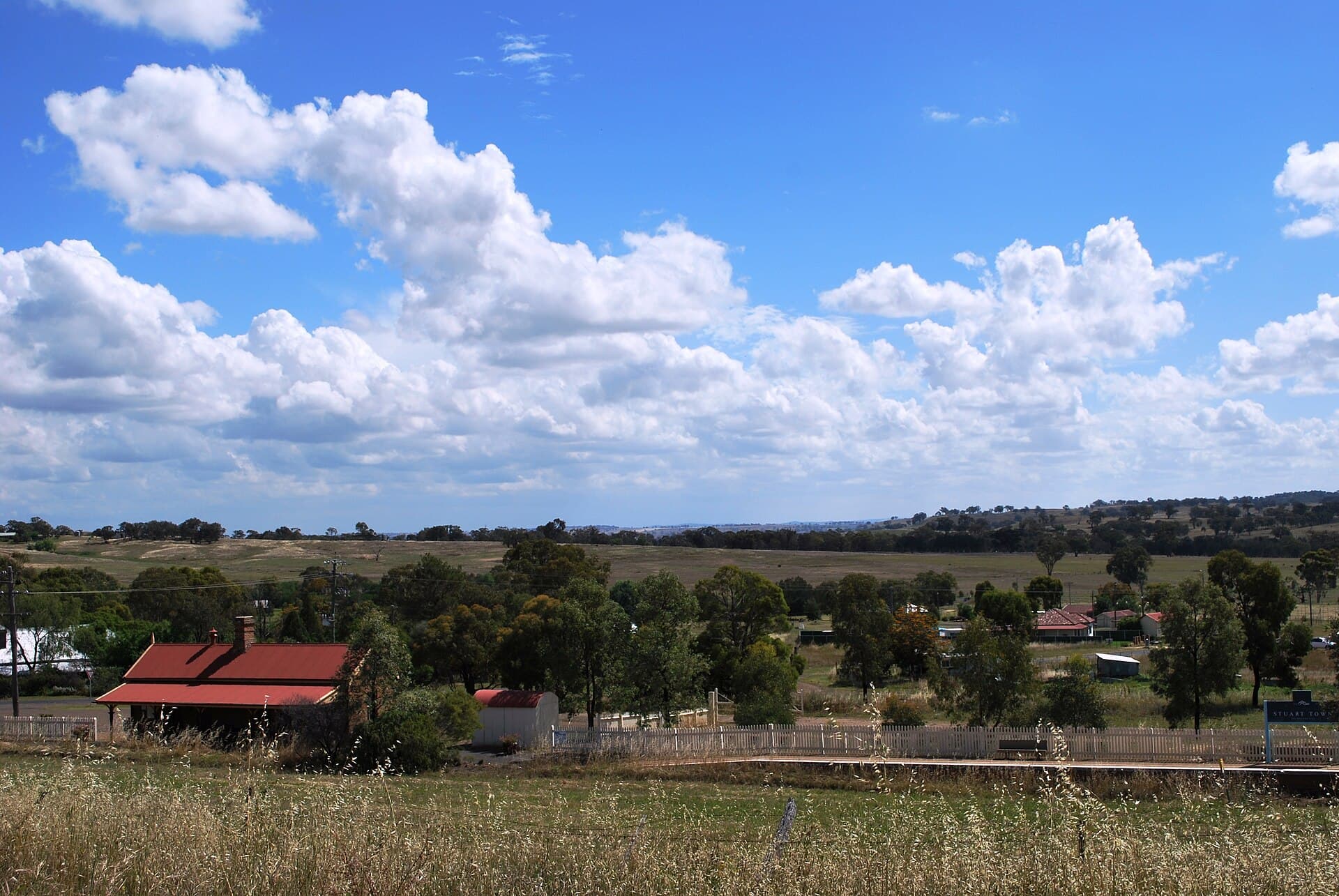
Stuart Town Common
Central West. on the edge of Stuart Town.
Gazetted
2 November 2001
Mapped size
3 hectares
Nearest town
Stuart Town
Photo: Mattinbgn (CC BY-SA 3.0). Wikimedia Commons.
Location
Gold marker: the middle of Stuart Town Common. Dark marker: Stuart Town.
Fossicking district
The gold line is the gazetted fossicking district. Inside it, you do not need an exploration licence holder's consent. The line is not landholder permission, and it is not the only place fossicking can be lawful in New South Wales.
Line simplified from Geological Survey of NSW fossicking districts, CC BY
History
Stuart Town Common is a fossicking district on town common. It was gazetted on 2 November 2001 and covers about 3 hectares. The ground sits on the edge of Stuart Town.
It carries forward former fossicking area 56, one of the old fossicking areas remade as districts in November 2001.
Stuart Town was called Ironbarks. Gold came from Mookerawa Creek and the reefs around the village, and the old name stuck. This is one of two fossicking districts on the town common, remade from former fossicking areas in 2001.
The mapped ground itself has no gold, gem, or metal point inside it in the state inventory. Within 3 kilometres of its centre, the same inventory records Gold (52), and Copper (6). On a small creek district, the old working is often beside the line rather than on it.
What you can find
The counts below sit within 3 kilometres of the mapped line. They are not a guarantee the mineral is inside the district itself.
Within 3 kilometres of this district, gold is the main mineral the survey records. Work gravel with a pan or a detector, keep holes small, and put the ground back. Gold on a mining lease still needs the lease holder's consent.
Base metals appear beside the main target. Old copper, lead, and zinc shows are often on leases or private paddocks. Colour in a rock is not permission to break it.
Anything you keep has to fit the state take-home limits: 50 grams of gold in any 48 hours, up to five nuggets of 10 grams or more, 100 grams of gemstones, 10 kilograms of gold or gem-bearing material, and 5 kilograms of other minerals. Publicly owned minerals found while fossicking lawfully become yours. No royalty is charged on them.
These names come from survey points within 3 kilometres of the mapped centre, not from inside the line itself.
Getting there
Stuart Town is on the Mitchell Highway between Orange and Wellington. This district is on the edge of Stuart Town.
A town common is managed land. Check with the council or the common trust before you dig, and stay inside the mapped common.
Open the district on the Dig Here map before you drive. The map shows this boundary against current titles, which a printed description cannot keep up to date.
Camping
The gazette notice does not create a campground. Plan to stay in Stuart Town unless you already have permission to camp on the land you are visiting.
Showgrounds and caravan parks in Stuart Town change with the season. Book what the local council currently lists, and do not assume a creek flat is free camping.
Important notes
- !Inside a fossicking district you still need the landholder's permission on private land. You do not need the exploration licence holder's consent. A mining lease, mineral claim, or opal prospecting licence still needs that holder's consent.
- !Hand tools only. A pan, sieve, pick, shovel, non-powered sluice, and metal detector fit the rules. Pumps, dredges, powered trommels, and machinery do not.
- !Disturb no more than one cubic metre of ground in any 48 hours, put the soil back, and take your rubbish with you.
- !On native title land or water you need the registered native title body's consent. The only tools allowed there are hand-held, and digging or clearing is not permitted.
- !Mineral counts on this page are locations from the Geological Survey of NSW. They are not grades.
Nearby districts
Open Stuart Town Common on the map
Titles change. Check this boundary against current leases before you dig.
Open mapDistrict boundaries and mineral counts are from the Geological Survey of NSW, CC BY. The words on this page are Dig Here's. Read the current rules on the NSW Resources fossicking page and check titles in MinView.