Licence, permit or permission: what you need to fossick for gold and gems in NSW, Queensland, Victoria, WA, SA, Tasmania, the NT and the ACT, and how to check any spot before you dig.
It is the question we get asked more than any other: do I need a licence to go looking for gold? The honest answer is that it depends on two things. Which state you are in, and whose ground you are standing on. A licence only ever covers the first part. Plenty of people have bought the right licence and still ended up somewhere they were not allowed to be.
So this guide does both. First, what each state asks you to carry. Then, the part that catches people out: mining titles and private land, and how to check any spot in a few seconds before you dig.
The short version
- New South Wales: no fossicking licence. You need permission to be on the land, or a Forestry Corporation permit for State forests.
- Queensland: a fossicking licence.
- Victoria: a Miner's Right.
- Western Australia: a Miner's Right.
- South Australia: no general fossicking licence. Permission to be on the land is what counts.
- Tasmania: no licence inside the 11 declared fossicking areas. A prospecting licence everywhere else.
- Northern Territory: an NT fossicking permit (free, required since 5 June 2026). You may also need to notify or get consent from the landholder or title holder.
- ACT: no fossicking licence, and no fossicking areas. Most public land is reserve, which is closed to collecting.
New South Wales
NSW does not sell a fossicking licence. If you are allowed to be on the land, fossicking with hand tools is lawful. What matters is whose land it is.
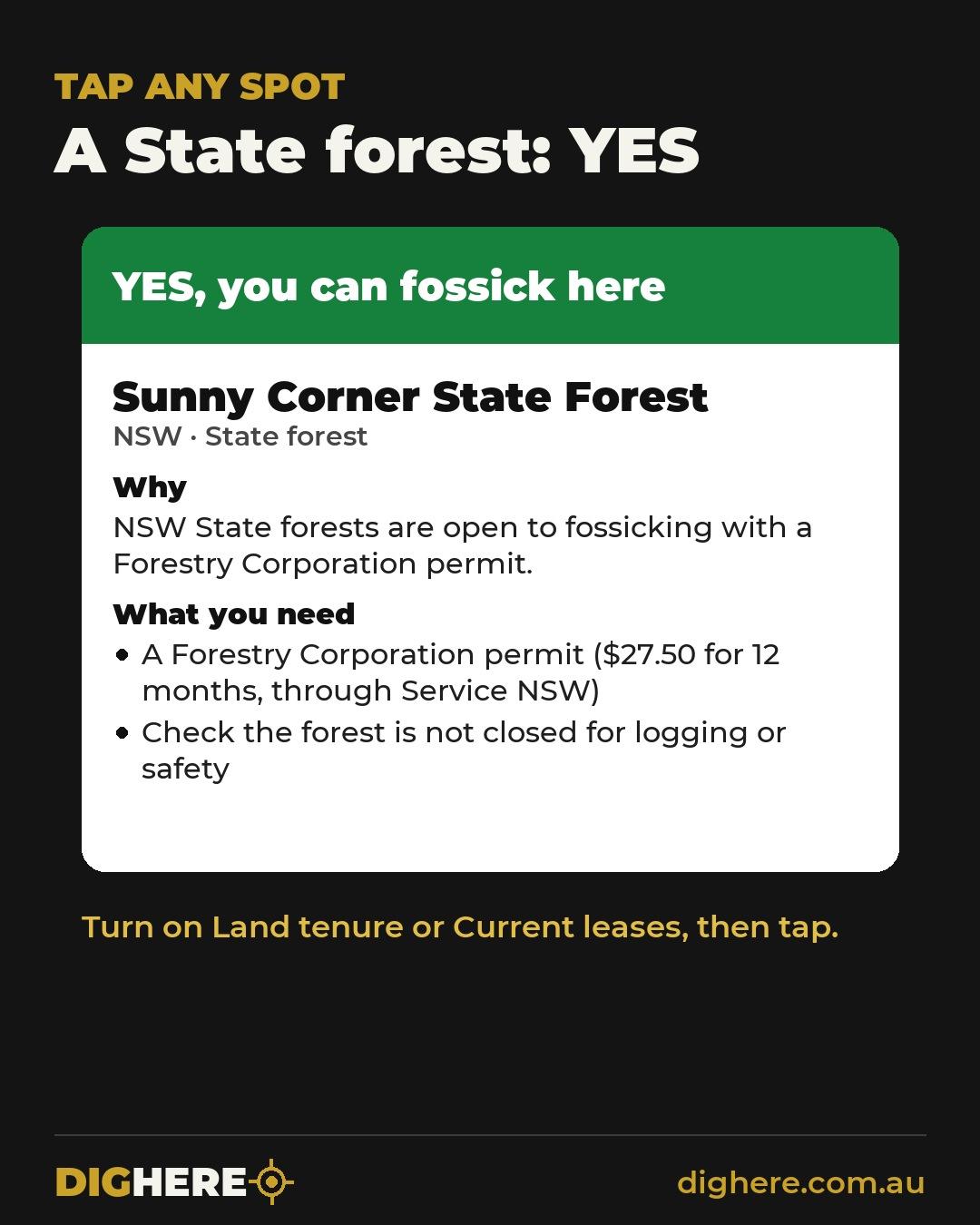
- State forests: one Forestry Corporation permit covers every State forest in NSW. It is $27.50 for 12 months, through Service NSW. Some compartments close for logging or safety, so check before you go.
- Fossicking districts: there are 70 of them. Inside one, you do not need an exploration licence holder's consent. You still need the landholder's OK, and mining leases and claims are still off limits without the holder's consent. All 70 NSW districts
- Private land: ask the landholder and get a clear yes.
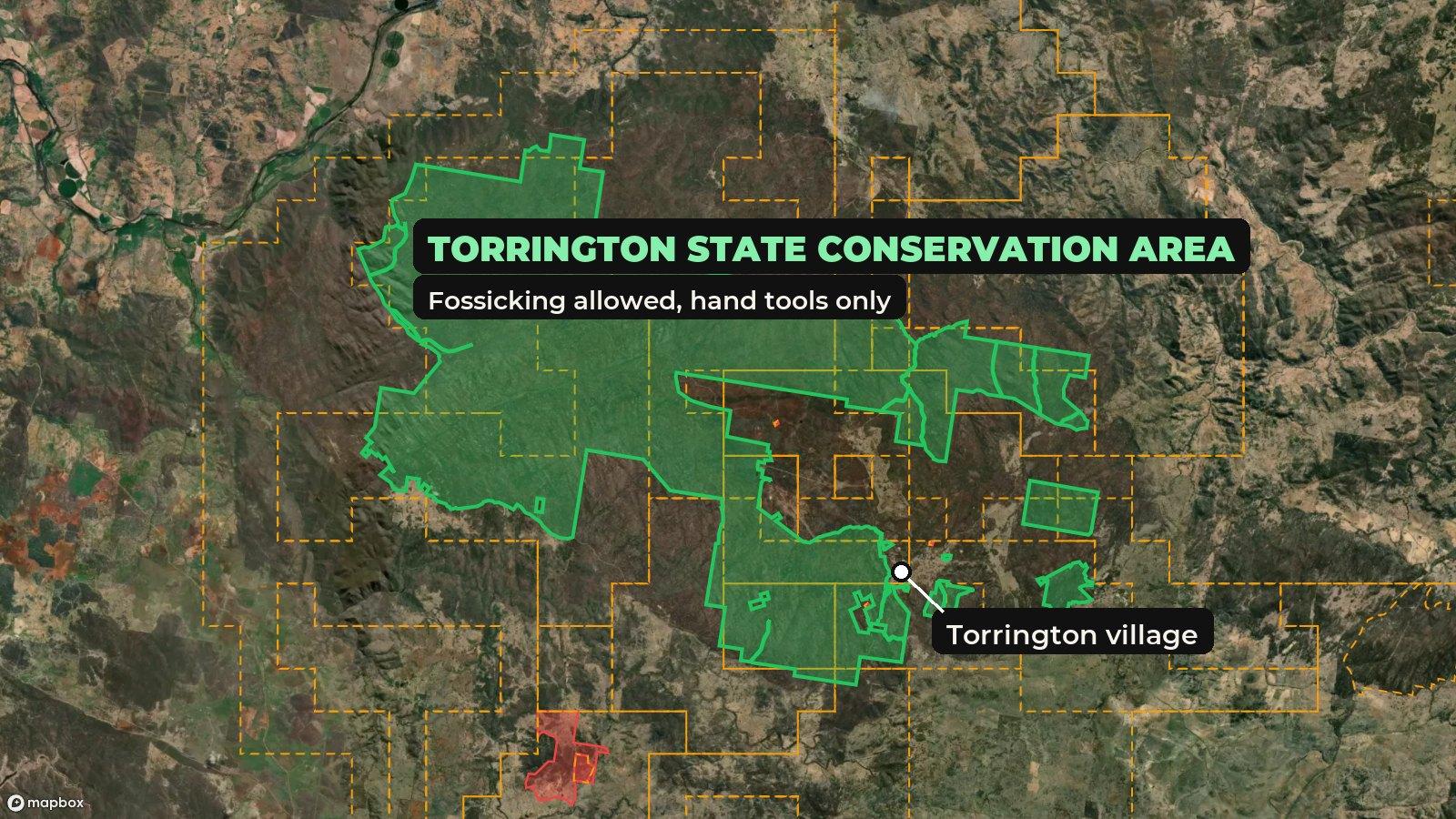
- National parks: stay out, apart from three named reserves where NPWS allows fossicking: Torrington State Conservation Area, Grove Creek in Abercrombie Karst Conservation Reserve, and Nuggetty State Conservation Area away from the banks and flats of Tuena Creek.
- Hand tools only, and disturb no more than a cubic metre of ground in 48 hours. Fill your holes.
More detail, region by region: Where to find gold in NSW.
Queensland
You need a Queensland fossicking licence, and you have to carry it (on paper or on your phone). You can buy one online in a few minutes, for a month, six months or a year, and a family licence covers the household. The fees are indexed every July: a year for one person was $63.73 at the last change we checked. Tourist mines that charge an entry fee are covered without a licence.
The licence lets you fossick in Queensland's fossicking areas, designated fossicking land and general permission areas. Anywhere else, you also need the landholder's written permission. More: Where to find gold in Queensland.
Victoria
You need a Miner's Right. It costs $29.40 and lasts 10 years, for individuals only. Carry it whenever you are out. Under-18s can fossick with an adult who holds one. It covers most State forest and unreserved Crown land, but not national parks (apart from Parks Victoria's designated prospecting areas), and not a mining, prospecting or retention licence without the holder's consent. Exploration licences don't stop you.
Western Australia
You need a Miner's Right, which is $30 under the 2026-27 fee schedule. It lets you prospect on Crown land with hand-held tools, including a metal detector, and keep samples up to 20 kg. To prospect inside an exploration licence without the holder's written permission, you need a separate Section 40E permit. Mining leases are off limits without the holder's permission.
South Australia
South Australia has no general fossicking licence for gold. Everything you collect is for your own collection: you cannot sell it. You need the landholder's permission on private land, and the Department for Environment and Water's consent on Crown land. You cannot fossick on a mineral claim, mining lease or retention lease without the holder's approval, although an exploration licence on its own does not need permission. National parks, conservation parks and forest reserves are closed, apart from the designated fossicking areas in Mount Crawford Forest, which need a ForestrySA permit. Hand tools only.
Tasmania
Inside any of Tasmania's 11 declared fossicking areas you do not need a licence, but metal detectors are not allowed there. Everywhere else you need a prospecting licence from Mineral Resources Tasmania, for recreational use only. With it you can use hand tools and a metal detector, with the consent of the landowner or tenement holder. Dredges, trommels and motorised pumps are banned. Reserves are managed by Parks and Wildlife, with their own rules.
Northern Territory
Since 5 June 2026 you need an NT fossicking permit to fossick anywhere in the Territory. It is free, lasts up to five years, and you apply with the form on fossicking.nt.gov.au. Fossicking without one is an offence. You may also need to notify, or get consent from, the landholder, occupier or title holder first. On a pastoral station that means 7 days' notice, and for gold on an exploration licence, 14 days' notice to the holder. Declared fossicking areas such as Arltunga and Warrego have their own conditions. Proposed fossicking areas need the Minister's consent first. Sacred sites are off limits, national parks need a Parks NT request, and Aboriginal land needs the Land Council's written consent. NT fossicking areas
Australian Capital Territory
The ACT has no fossicking licence and no declared fossicking areas. Most of the territory is Namadgi National Park and other nature reserves, where taking rock, soil or minerals is not allowed. On private or leased land you need the landholder's permission. In practice, Canberra fossickers head over the border into NSW, where State forests within an easy drive are open on the one Forestry Corporation permit. NSW fossicking guide
The part a licence does not cover: whose ground is it?
This is where people come unstuck. A mining lease or claim is someone's ground, and it does not matter that you are after gold and their title is for tin or gemstones. Walk onto it without permission and you are trespassing on their title. Exploration licences are different again, and the rules change from state to state.
So we put every mining title on the Dig Here map: leases, claims and exploration licences for every mineral, in NSW, Queensland, Victoria, WA, SA and Tasmania, refreshed from the government registers every week. The NT is coming. Turn on Land tenure or Current leases, tap any spot, and the map gives you a straight YES or NO, the reason, and what you need.
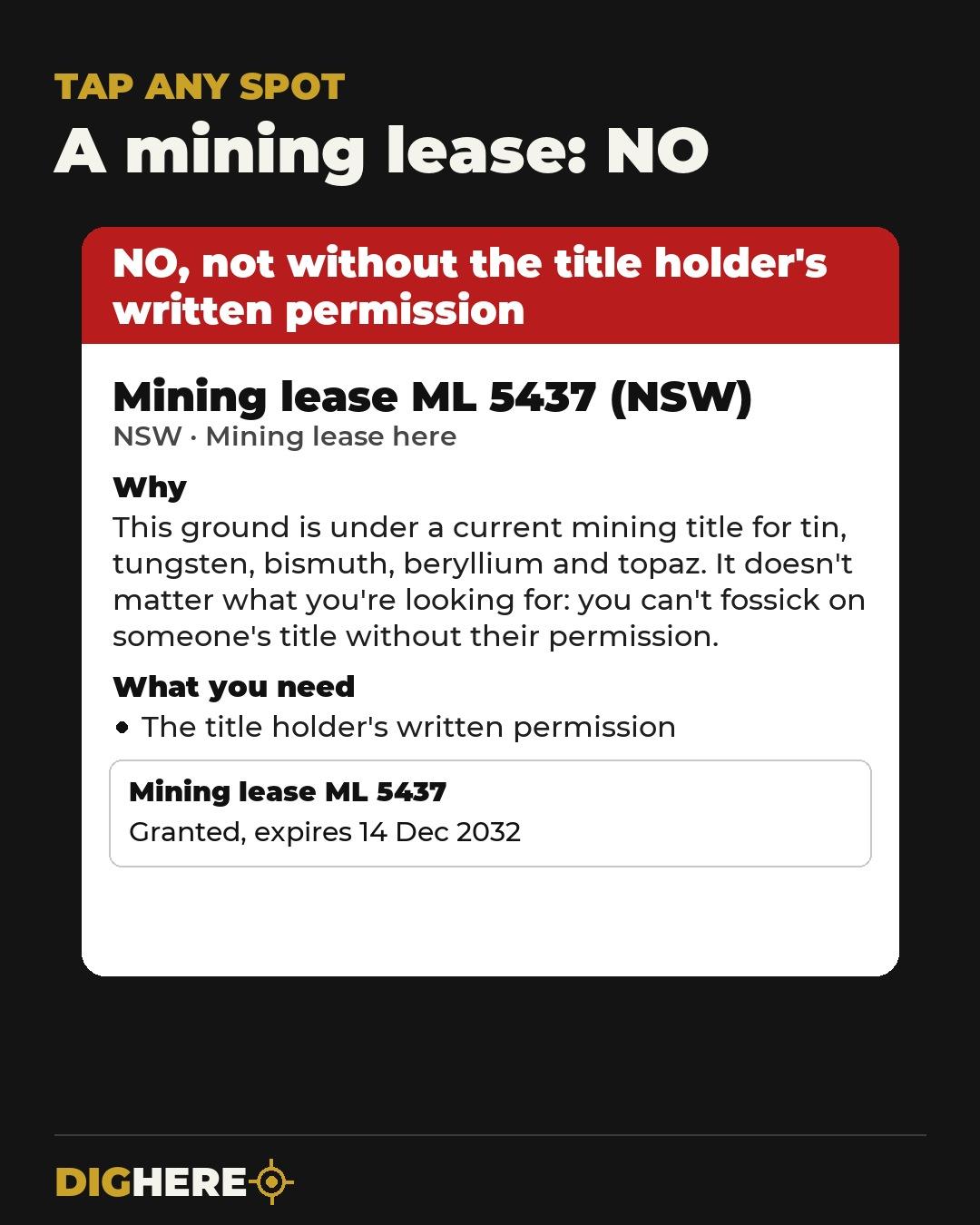
Got a title number from a sign or a mate? Type it into the map search, for example ML 5437 or M 15/1234, and it takes you straight there.